
Many tea drinkers describe tea using simple terms such as “sweet,” “bitter,” or “strong.” While these descriptions are useful, they only capture a small part of the overall tea experience.
Professional tea tasters evaluate tea much differently. Rather than focusing on a single flavor, they analyze the tea through a combination of appearance, aroma, taste, mouthfeel, and aftertaste.
This process, known as tea cupping, allows teas from different origins, harvests, and grades to be evaluated consistently and objectively.
What Is Tea Cupping?
Tea cupping is the standardized method used by tea buyers, exporters, quality control teams, tea estates, and professional tea tasters to evaluate tea quality.
To ensure consistency, many tea professionals follow ISO 3103, the international standard for tea preparation during sensory evaluation.
The purpose of tea cupping is not enjoyment. Instead, it is designed to reveal both the strengths and weaknesses of a tea as clearly as possible.
Professional tasters typically evaluate tea through four major areas:
- Dry Leaf Evaluation
- Wet Leaf Evaluation
- Liquor Appearance
- Liquor Taste & Mouthfeel
Dry Leaf Evaluation
The evaluation begins before any water touches the leaf.
Tea tasters examine the dry leaf to assess quality, manufacturing consistency, and grading.
Common observations include:
- Leaf appearance and color
- Leaf size and uniformity
- Degree of rolling or twisting
- Presence of buds or tips
- Foreign materials or contamination
For example, a tea containing a high proportion of young buds often indicates careful plucking and premium leaf material. Uniformity is also important because consistent leaves usually produce a more predictable and balanced cup.
Wet Leaf Evaluation
After brewing, the infused leaves are examined again.
This stage often reveals information that cannot be seen in the dry leaf.
Tea tasters evaluate:
- Aroma intensity
- Aroma complexity
- Leaf color
- Uniformity of extraction
- Manufacturing defects
A well-made Green Tea should reveal healthy green leaves after infusion, while Black Tea should display an even coppery-brown appearance. Uneven coloration may indicate inconsistent processing.
Wet leaf evaluation is also one of the best ways to detect defects such as over-firing, excessive oxidation, staleness, or improper storage.
Liquor Appearance
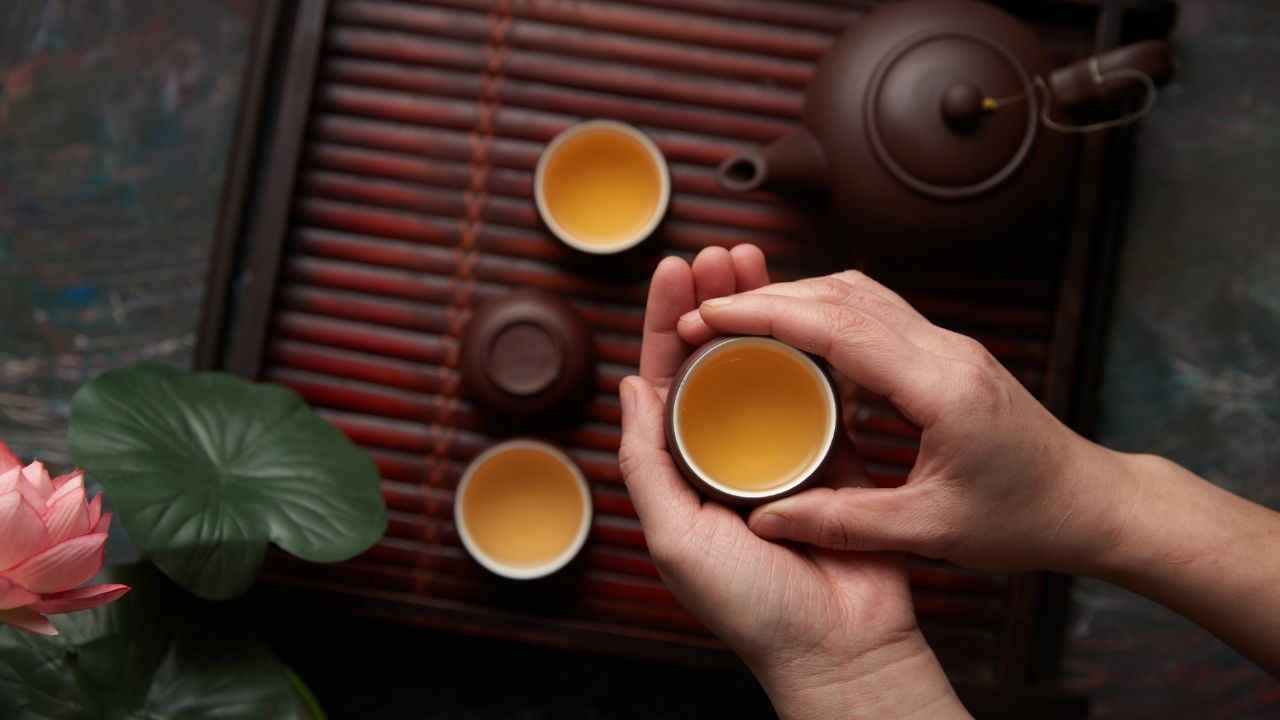
Before tasting, the brewed tea itself is visually examined.
Professional tasters look for three key characteristics:
Brightness
Brightness refers to how lively and reflective the liquor appears.
A bright tea looks vibrant and energetic, while a dull tea often appears flat or lifeless.
Clarity
Clarity refers to the absence of unwanted particles or haze.
Most teas are expected to appear clear, although some Japanese teas such as Sencha naturally produce a slightly cloudy appearance due to fine leaf particles.
Depth of Color
Color should match the style of tea being evaluated.
For example, a premium Black Tea may display a rich reddish-gold liquor, while a Green Tea should maintain a lighter green-yellow appearance.
Liquor Taste & Mouthfeel
This is often considered the most important stage of tea evaluation.
Professional tasters use a technique known as slurping, drawing the tea rapidly across the palate. This spreads the liquid throughout the mouth while simultaneously carrying aromatic compounds into the nasal cavity.
The result is a more complete sensory evaluation.
During this stage, tea professionals assess several key characteristics.
Bitterness: The Structural Backbone
Bitterness is one of the five basic human tastes.
In tea, it comes primarily from caffeine and catechins.
Many consumers assume bitterness is undesirable. Professional tasters see it differently.
A moderate level of clean bitterness provides structure, liveliness, and complexity. Without bitterness, many teas would taste flat and lack character.
The key question is not:
Is the tea bitter?
The better question is:
Is the bitterness clean, balanced, and pleasant?
Excessive bitterness, however, often indicates over-extraction, poor brewing, or lower-quality leaf material.
Astringency: The Drying Sensation
Astringency is frequently confused with bitterness.
They are not the same thing.
Bitterness is a taste.
Astringency is a physical sensation.
In Indonesia, many people describe this sensation as “sepet.”
When drinking an astringent tea, the mouth may feel dry, rough, or slightly puckered. The sensation is similar to red wine or an unripe banana.
This occurs when polyphenols bind to proteins in saliva, temporarily reducing the mouth’s natural lubrication.
A moderate level of astringency can create freshness and structure. Excessive astringency may indicate poor brewing or lower-quality leaf material.
Body: The Weight of the Tea
Body refers to the weight and texture of the tea in the mouth.
It is not a flavor but a tactile sensation.
A useful comparison is milk:
- Skim milk feels light.
- Whole milk feels richer.
- Cream feels dense and heavy.
Tea behaves similarly.
Silver Needle White Tea often feels light and delicate. Sencha typically has a medium body. High-mountain Oolongs may feel silky or creamy, while robust Black Teas can feel rich and full-bodied.
For many experienced tea drinkers, body is just as important as flavor.
Umami: The Savory Taste
Umami is one of the five basic human tastes alongside sweet, sour, salty, and bitter.
It is often described as savory, brothy, rich, or deeply satisfying.
In tea, umami comes primarily from amino acids, especially L-theanine.
Umami is most closely associated with Japanese teas such as Sencha, Gyokuro, and Matcha. Shading techniques used before harvest increase amino acid levels, resulting in a richer and more savory cup.
While bitterness provides structure, umami contributes depth, softness, and roundness.
Aftertaste vs. Hui Gan
One of the hallmarks of great tea is what happens after swallowing.
Professional tasters pay close attention to aftertaste because it often reveals quality and complexity.
A general aftertaste refers to any flavor or sensation that lingers after the tea has been swallowed.
A Jasmine Tea may leave floral notes. A roasted tea may leave nutty or caramelized notes. A highly astringent tea may leave a drying finish.
All of these are examples of aftertaste.
Hui Gan is something more specific.
The Chinese term Hui Gan (回甘) is commonly translated as “returning sweetness.”
A tea with strong Hui Gan may initially present slight bitterness or astringency. Then, several seconds later, a refreshing sweetness begins to emerge from the back of the throat and spread across the mouth.
Rather than tasting sweet immediately, the sweetness appears after the tea is gone.
This phenomenon is highly valued among tea enthusiasts and is often found in high-quality Green Teas, White Teas, Oolongs, and Sheng Pu-erh teas.
Balance: The Ultimate Measure of Quality
One of the biggest misconceptions in tea appreciation is the belief that great tea should be completely free of bitterness or astringency.
Professional tea tasters do not look for the strongest sweetness, the most umami, or the longest Hui Gan.
They look for balance.
A tea may contain bitterness, astringency, body, sweetness, umami, aroma, and Hui Gan simultaneously. What matters is how well these elements work together.
The finest teas are rarely defined by a single characteristic. Instead, they achieve harmony across multiple sensory dimensions.
Why Do Tea Tasters Slurp?
Many newcomers are surprised to see professional tea tasters slurp tea loudly.
This is intentional.
Slurping atomizes the tea into tiny droplets and spreads it across the entire palate while simultaneously pushing aromatic compounds into the nasal passages.
This allows the taster to evaluate flavor, aroma, texture, and aftertaste more accurately than simply sipping the tea.
Final Thoughts
Professional tea evaluation is about much more than determining whether a tea tastes good or bad.
Every cup contains a combination of appearance, aroma, flavor, texture, and aftertaste. Understanding concepts such as bitterness, astringency, body, umami, and Hui Gan allows tea drinkers to experience tea with the same vocabulary used by professional tasters around the world.
The next time you drink tea, slow down and pay attention to what you see, smell, taste, and feel. You may discover far more complexity in the cup than you ever noticed before.